


As businesses grow, so do their staffing needs. Choosing between hiring a Virtual Assistant Vs employee (full-time or Part-time) can be a pivotal decision. Both options have their benefits, but the right choice depends on factors like cost, tasks, and efficiency. This guide explores the key differences to help you decide which is best for your business.
1. Virtual Assistant vs Employee: Cost Comparison
When deciding between hiring a Virtual Assistant Vs employee, cost is often a critical factor. Below is a detailed comparison to help you understand the financial implications of each option.
Virtual Assistants: A Cost-Effective Solution
- Pay-As-You-Go Model:
- Virtual Assistants are typically paid only for the hours worked or specific tasks completed.
- Ideal for businesses with fluctuating workloads or seasonal demands.
- No Overhead Costs:
- VAs work remotely, eliminating the need for office space, utilities, and equipment.
- This significantly reduces operational expenses.
- No Benefits or Payroll Taxes:
- Unlike traditional employees, VAs are independent contractors, so businesses don’t have to cover:
- Health insurance.
- Retirement contributions.
- Paid leave or other benefits.
- No payroll taxes or long-term commitments.
- Unlike traditional employees, VAs are independent contractors, so businesses don’t have to cover:
Traditional Employees: A Fixed Expense
- Fixed Salaries:
- Full-time employees require consistent monthly pay, regardless of workload or business performance.
- This can strain budgets during low-demand periods.
- Additional Costs:
- Employers are responsible for:
- Taxes (income, national insurance contributions).
- Benefits (healthcare, pensions, holiday pay).
- Training and onboarding programs to upskill employees.
- Employers are responsible for:
- Overhead Expenses:
- Traditional employees require office space, equipment (desks, computers), and supplies.
- Utilities and other facility-related expenses add to the overall cost.
Conclusion: Virtual Assistants Are More Affordable
In conclusion, the choice between virtual assistants vs employee is clear for businesses looking to reduce costs while maintaining flexibility; Virtual Assistants provide a clear advantage. Their pay-as-you-go model, lack of overhead expenses, and exemption from benefits make them an attractive choice for:
- Small businesses with limited budgets.
- Companies with fluctuating or short-term staffing needs.
In contrast, traditional employees are better suited for roles requiring long-term commitment and in-person collaboration, though they come with significantly higher costs. For most small or growing businesses, Virtual Assistants offer the ideal balance of affordability and efficiency.
2. Virtual Assistant vs Employee: Flexibility and Scalability
When it comes to adapting to changing business needs, the choice between Virtual Assistant vs employee can significantly impact flexibility and scalability. Here’s how they compare:
Virtual Assistants: Designed for Flexibility
- On-Demand Availability:
- VAs can be hired for specific projects, hours, or tasks.
- Businesses can easily scale their support up or down, depending on seasonal demands or workload fluctuations.
- Global Talent Pool:
- Virtual Assistants work remotely, allowing you to hire skilled professionals from anywhere in the world.
- This broadens your access to specialised expertise, often at competitive rates.
- Specialised Skills:
- Many VAs specialise in specific areas such as social media management, e-commerce, graphic design, or administrative support.
- You can hire VAs tailored to meet your exact needs, ensuring efficiency and quality.
Traditional Employees: Fixed and Localised
- Fixed Work Hours:
- Employees generally adhere to set schedules, which may not align with peak business hours or changing needs.
- This rigidity can be a drawback for businesses with fluctuating demands.
- Local Talent Pool:
- Traditional recruitment is often limited by location, reducing access to diverse and global skill sets.
- Geographic constraints can limit the availability of specialised expertise.
- Generalised Roles:
- Employees are often required to handle a wide range of tasks, which can dilute their focus and efficiency.
- This generalisation may not match the specialised needs of certain projects or business functions.
Conclusion: Virtual Assistants Offer Superior Flexibility
For businesses that experience shifting demands or require access to specialised skills, Virtual Assistants provide unmatched flexibility and scalability. The ability to hire on-demand, tap into a global talent pool, and focus on specialised tasks makes VAs the ideal solution for:
- Startups and small businesses with variable workloads.
- Companies expanding into new markets or launching time-sensitive projects.
On the other hand, traditional employees may be better suited for long-term, in-house roles but often lack the flexibility and scalability needed in dynamic business environments. For most modern businesses, VAs deliver the adaptability required to stay competitive and efficient.
3. Virtual Assistant vs Employee: Task Management
When deciding how to allocate responsibilities in your business, understanding the strengths of Virtual Assistants vs employees is essential. Here’s a comparison of how they handle task management:
Virtual Assistants: Ideal for Routine or Specific Tasks
- Best for Repetitive or Specialised Tasks:
- VAs are highly efficient in handling specific, well-defined tasks that don’t require extensive company integration. Examples include:
- Administrative Support: Email management, calendar scheduling, data entry.
- Social Media Management: Content creation, scheduling, and engagement.
- Customer Support: Responding to inquiries via email or live chat.
- E-Commerce Assistance: Managing product listings, inventory updates, and order processing.
- VAs are highly efficient in handling specific, well-defined tasks that don’t require extensive company integration. Examples include:
- Efficient Execution:
- With clear instructions and access to the right tools, VAs can execute tasks quickly and independently.
- They are skilled at following processes, ensuring consistent and high-quality results.
Traditional Employees: Better for Core Business Roles
- Best for Long-Term, Strategic Responsibilities:
- Employees are well-suited for roles that require a deeper connection to your company, such as:
- Management positions.
- Client-facing roles that build long-term relationships.
- Leadership in developing company strategy and vision.
- Employees are well-suited for roles that require a deeper connection to your company, such as:
- Multitasking Capabilities:
- Employees often handle a variety of responsibilities across multiple functions.
- However, juggling diverse tasks can sometimes dilute their focus and reduce efficiency.
Conclusion: Task-Based vs. Strategic Roles
- Virtual Assistants are perfect for task-based or project-specific work, such as managing routine or repetitive responsibilities. Their focus and efficiency allow business owners to delegate tasks confidently and free up time for strategic planning.
- Traditional Employees are better suited for roles that demand long-term engagement, leadership, or alignment with company culture. While they can multitask, their strengths lie in roles that benefit from deep integration with the business.
For most businesses, a hybrid approach – utilising VAs for specific tasks and employees for core roles – offers the best balance of efficiency and strategic alignment.
4. Virtual Assistant vs Employee: Training and Onboarding
Training and onboarding are critical components of integrating new team members. When deciding between virtual assistants vs employees, it’s important to note that Virtual Assistants (VAs) and traditional employees differ significantly in the time, effort, and resources required for this process. Here’s a detailed comparison:
Virtual Assistants: Quick and Minimal Onboarding
- Minimal Training Needed:
- VAs are typically experienced professionals with expertise in their respective fields, such as social media management, customer support, or e-commerce assistance.
- They require little to no training beyond understanding your specific processes or tools.
- Quick Onboarding:
- VAs can start contributing immediately with a clear outline of tasks and goals.
- Remote work eliminates logistical delays, such as setting up office space or equipment.
- Pre-Vetted Skills:
- Many agencies, like Virtualy.net, provide pre-screened VAs who are already proficient in key skills, ensuring businesses get professionals ready to deliver results from day one.
Traditional Employees: Time-Intensive Training and Onboarding
- Extensive Training Required:
- Employees often need weeks or months of onboarding, especially for specialised roles.
- Training may include learning company policies, software, workflows, and industry-specific knowledge.
- Longer Hiring Process:
- Recruitment involves advertising the role, screening resumes, conducting interviews, and negotiating contracts.
- Once hired, employees may need further training to meet company-specific requirements, extending the time before they can fully contribute.
Conclusion: Faster and Streamlined Onboarding with VAs
- Virtual Assistants provide a quick, efficient solution for businesses that need immediate support. Their minimal training requirements and pre-vetted expertise allow businesses to save time and focus on operations rather than extensive onboarding.
- Traditional Employees are better suited for roles that require long-term investment and alignment with company culture but come with higher time and resource commitments for recruitment and training.
For businesses looking for a fast, cost-effective staffing solution, VAs deliver unmatched efficiency in onboarding and training, making them ideal for short-term or immediate needs.
5. Virtual Assistant vs Employee: Productivity and Efficiency
Maximising productivity and efficiency is essential for any business. When deciding between virtual assistants vs employees, it’s important to note that Virtual Assistants (VAs) and traditional employees bring distinct advantages depending on the nature of the work. Here’s how they compare:
Virtual Assistants: Task-Specific Focus
- Focused Output:
- VAs are hired for specific tasks or projects and work exclusively on those during billed hours.
- This ensures a high level of focus and productivity without distractions from unrelated responsibilities.
- Task-Specific Expertise:
- Many VAs have specialised skills in areas like social media management, customer support, or administrative tasks.
- Their expertise allows them to complete tasks more efficiently and effectively than generalists.
- Fewer Distractions:
- Remote work setups often eliminate common workplace distractions like meetings, office noise, or unnecessary interruptions.
- This allows VAs to dedicate their full attention to the assigned tasks.
Traditional Employees: Broader Scope and Collaboration
- Team Collaboration:
- Being physically present in an office makes it easier for employees to collaborate, brainstorm, and contribute to team dynamics.
- This is particularly valuable for projects requiring input from multiple departments.
- Broader Responsibilities:
- Employees can take on a variety of tasks and pivot between priorities as needed.
- However, multitasking can sometimes dilute focus and reduce overall efficiency.
- Office Environment:
- While collaboration and communication are facilitated in an office, the environment can also bring distractions such as impromptu meetings, social interactions, and noise.
Conclusion: Task-Specific vs. Collaborative Efficiency
- Virtual Assistants are highly productive when it comes to task-specific work. Their remote setup and specialised skills enable them to deliver focused, efficient results without distractions.
- Traditional Employees excel in roles that require ongoing collaboration, teamwork, and adaptability to a broad range of tasks, though office environments may introduce inefficiencies.
For businesses prioritising individual task execution, Virtual Assistants are the clear choice. However, for roles requiring constant interaction and cross-functional collaboration, traditional employees may be better suited. Depending on your needs, a combination of both can optimise productivity across your organisation.
6. Virtual Assistant vs Employee: Commitment and Long-Term Roles
When deciding between virtual assistants vs employees, the nature of the role and the required level of commitment are key considerations. Both options offer unique advantages depending on your business needs.
Virtual Assistants: Flexible and Short-Term Engagements
- Short-Term Engagements:
- VAs are ideal for businesses needing support for specific projects or seasonal workloads.
- Their flexibility allows businesses to engage them on-demand, scaling up or down as needed.
- Contract-Based Work:
- VAs typically work under contract, making it easier to end the engagement if business needs change.
- This makes VAs a low-risk option for businesses navigating uncertainty or fluctuating demand.
- Limited Integration:
- While VAs can provide excellent task-based support, they usually work independently and remotely.
- This means they may not engage deeply with your company culture or internal team dynamics.
Traditional Employees: Stability and Long-Term Commitment
- Long-Term Stability:
- Employees offer consistency and are invested in the organisation’s long-term success.
- They provide continuity for roles that require sustained engagement and in-depth knowledge of the company.
- Cultural Fit:
- Employees integrate into the organisation’s values, mission, and vision, creating a sense of belonging and loyalty.
- A strong cultural fit fosters teamwork and aligns employees with strategic goals.
- Deeper Collaboration:
- Employees contribute to the company’s long-term objectives, often taking on leadership roles and strategic initiatives.
- They are well-suited for roles requiring extensive collaboration with other departments or external stakeholders.
Conclusion: Task-Based Support vs. Long-Term Stability
- Virtual Assistants excel in roles that are project-based or involve auxiliary support, such as administrative tasks, marketing, or customer service. Their flexibility and ease of engagement make them ideal for businesses with short-term needs or fluctuating workloads.
- Traditional Employees are better suited for core roles requiring long-term commitment, deep cultural integration, and collaboration. They contribute to the company’s strategic direction and help build a stable foundation for growth.
For many businesses, a balanced approach—leveraging VAs for specific tasks and employees for long-term goals—can provide the best of both worlds.
Virtual Assistant Vs employee: Which is Right for Your Business?
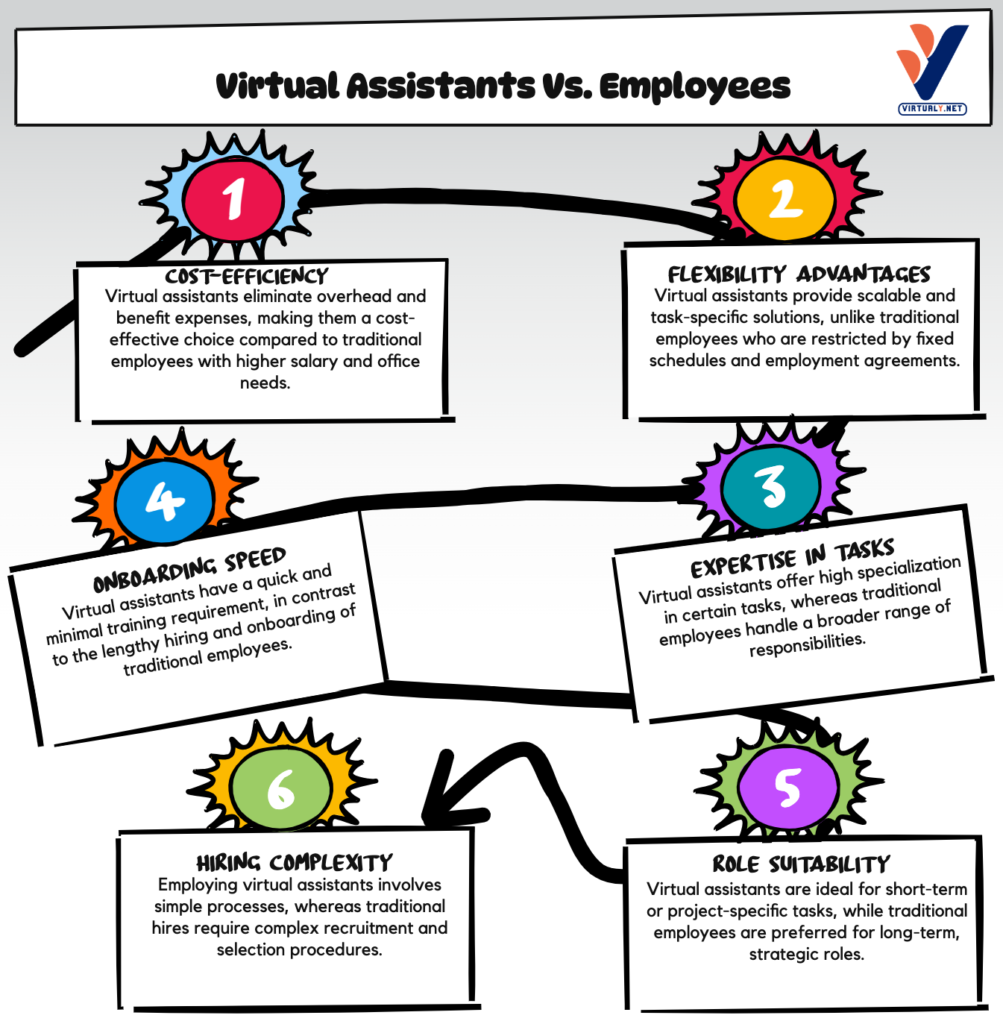
The choice between a Virtual Assistant Vs employee depends on your business needs, budget, and long-term goals. If you’re looking for cost-effective, task-specific support with flexibility, a Virtual Assistant is an excellent choice. For roles requiring long-term commitment and deep integration, a traditional employee might be the better fit.
Looking for the perfect Virtual Assistant? Contact Virtualy.net today to find the right support for your business needs!